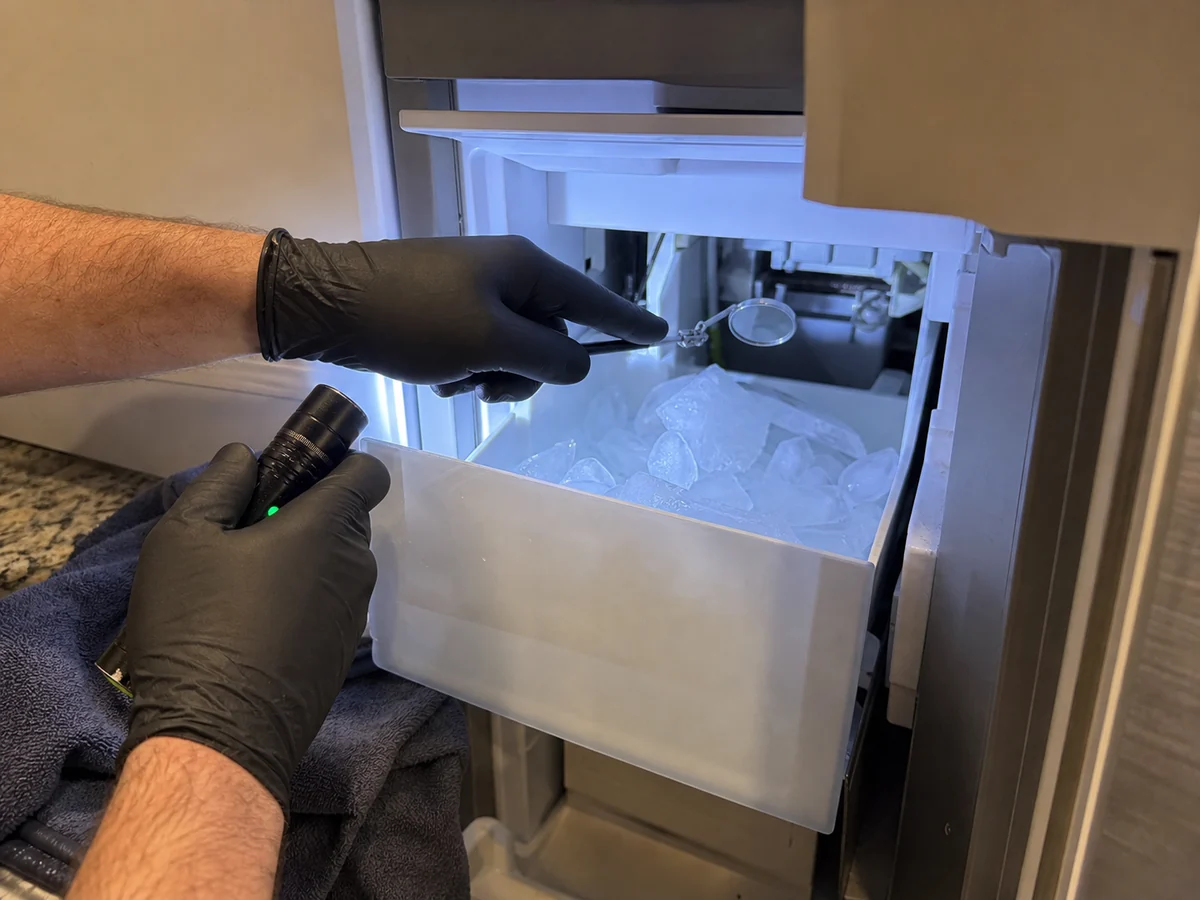
Sub-Zero freezer not freezing — a warm freezer is its own fault
A freezer that has drifted warm is not the same problem as a fridge that will not cool, and treating it like one wastes a visit. On a Sub-Zero freezer column or the freezer half of a built-in, the fault almost always lives in the defrost system, the evaporator fan, or the sealed system serving that one compartment. Here is how we read it — and the food-safety clock that says how fast to move.
Los Altos built-in kitchens are unusually fond of the column layout — a dedicated refrigerator column on one side, a dedicated freezer column on the other, often flanking a sink or a Wolf range in a remodel around North Los Altos or the Country Club area. That layout is a gift when the freezer warms, because there is no fridge compartment to blur the picture: the whole freezer cabinet drifts at once, and the symptom points squarely at that unit's own evaporator, fan and defrost circuit. It is also why we keep this page separate from the general not-cooling guide. The two faults overlap on the page but not under the panel.
The first thing we want is a real number. A freezer that "feels less cold" might be sitting at a perfectly safe 2°F, or it might be at 22°F and quietly thawing the contents from the inside out. The actual temperature decides both the diagnosis and the urgency, and on a freezer it is the difference between a routine appointment and a same-day call.
The freezer-specific causes
What makes a Sub-Zero freezer run warm
Defrost fault and evaporator frost
The freezer evaporator frosts over by design and clears itself on a defrost cycle. When the defrost heater, sensor or control stops doing that, frost builds into a solid block, airflow chokes, and the compartment warms even though the compressor is running. Heavy, even frost on the back panel is the tell.
Freezer evaporator fan
The fan that pushes cold air through the freezer can seize or weaken with age. The system is still making cold, but it is not moving it, so the box near the door warms while frost lingers on the coil. A fan that buzzes or rattles before it fails is worth catching early — see noisy and buzzing diagnosis.
Sealed system on the column
A freezer column has its own sealed system, and a slow refrigerant loss or a tired compressor shows up as a freezer that cannot reach 0°F no matter how long it runs. This is the costlier end, so we confirm it with gauge readings the way the sealed-system page describes before ever calling it.
Condenser loading and summer heat
A condenser caked with dry-season garden dust makes the whole sealed system run hot, and the freezer is usually the first compartment to lose ground on a warm Los Altos afternoon. Brushing the coil back to bare metal sometimes recovers the temperature on its own.
Food-safety clock
How long you have, and what not to do
A full freezer buys you time — roughly a day to two days unopened — but a half-empty one warms much faster, and every door opening spends the budget. Keep the door shut, do not pile in warm food hoping to "help it freeze," and do not run the unit through repeated manual defrost cycles, which can mask the very frost pattern we need to see. If contents have already softened, move the irreplaceable items to another freezer and book the visit. A warm freezer is one of the few symptoms where waiting costs more than the repair.
Step by step
How we read a warm freezer
Read the actual freezer temperature. Put a thermometer in the freezer for a few hours. A true freezer holds near 0°F; anything drifting toward the teens or twenties is the number that tells us how urgent this is.
Separate the freezer from the fridge. On a column or an over-under, decide whether only the freezer is warm or both compartments are. A warm freezer with a cold fridge is a very different fault from both being warm.
Look for heavy evaporator frost. If the freezer panel is caked in frost, a defrost fault is likely — the heater, sensor or timer has stopped clearing the coil and airflow chokes off.
Listen for the freezer fan. A silent or stuttering evaporator fan starves the compartment of cold air even when the system is making cold. A buzzing fan is a clue, not background noise.
Check the condenser and airflow. A condenser loaded with summer garden dust makes the sealed system run hot and lose ground on the freezer first. We brush it back and re-read before condemning anything bigger.
Next step
Match the fault to your model
Because a freezer column and an over-under freezer take different defrost and fan parts, the repair plan starts with your model number. If you can read the tag, the model number decoder explains what your platform implies, and the not-cooling diagnostic is the companion page if the fresh-food side is also warm. Every visit opens with the $89 diagnostic, which applies to the repair, and the work carries a 365-day warranty.
My Sub-Zero fridge is fine but the freezer is warm — what is wrong?
When only the freezer drifts warm, the usual causes are a defrost fault (frost choking the evaporator), a failed freezer fan, or a sealed-system issue on that compartment. A cold fridge with a warm freezer specifically rules out a few whole-unit causes, which is why we diagnose the freezer as its own problem rather than lumping it in with general not-cooling.
How is this different from the not-cooling page?
The not-cooling diagnostic covers a warm fresh-food side, where airflow and the fridge evaporator dominate. This page is about the freezer specifically — column freezers and the freezer half of an over-under fail through the defrost system, the freezer fan and sealed-system parts that the fridge side does not share.
How long is the food safe if the freezer is warming?
A full freezer holds cold for roughly 24-48 hours unopened, less if it is half empty or the door has been opened. Once contents soften above 0°F the clock is running, so a warming freezer is worth a same-week visit rather than a wait-and-see.
Do column freezers fail differently than a combo unit?
Yes. A dedicated freezer column has its own evaporator, fan and defrost circuit, so when it warms there is no fridge side to mask it — the whole box drifts at once. Many Los Altos built-in kitchens pair a freezer column with a separate fridge column, which makes pinning the fault to one cabinet straightforward.
Could summer heat be the cause?
It can be the trigger. A condenser loaded with the fine dry-season dust common in Los Altos gardens makes the sealed system run hot, and the freezer is usually the first compartment to lose ground on a hot afternoon. Cleaning the coil is often part of the fix.
 Los Altos Sub-Zero Appliance Repair