Sub-Zero making noise — decode the buzz, rattle, or click
A Sub-Zero is one of the quietest appliances in the house, so when it starts to buzz, rattle, hum or click, you notice. The good news is that the sound itself is a diagnosis: a compressor buzz, a fan rattle, an ice-maker click and a normal defrost gurgle all come from different places. Naming the noise tells us which part to look at — and which sounds you can safely ignore.
There is a reason noise complaints cluster in towns like Los Altos. The homes are quiet — set back on leafy lots in Old Los Altos, the Highlands and up in the Hills, with none of the street hum a denser city carries — so a refrigerator that would disappear into background noise elsewhere becomes the loudest thing in an open-plan kitchen at night. Half the calls we take that begin "it's suddenly so loud" turn out to be a unit that has been making the same sound for months in a room that finally went quiet enough to hear it.
The other half are real, and the trick to sorting them is to treat the sound as evidence. Where does it come from? When does it happen? Is it electrical, mechanical, or rhythmic? Answer those three and you have usually named the part before a technician opens the lower grille.
Sound by source
Five noises and what each one is
Compressor buzz or hum
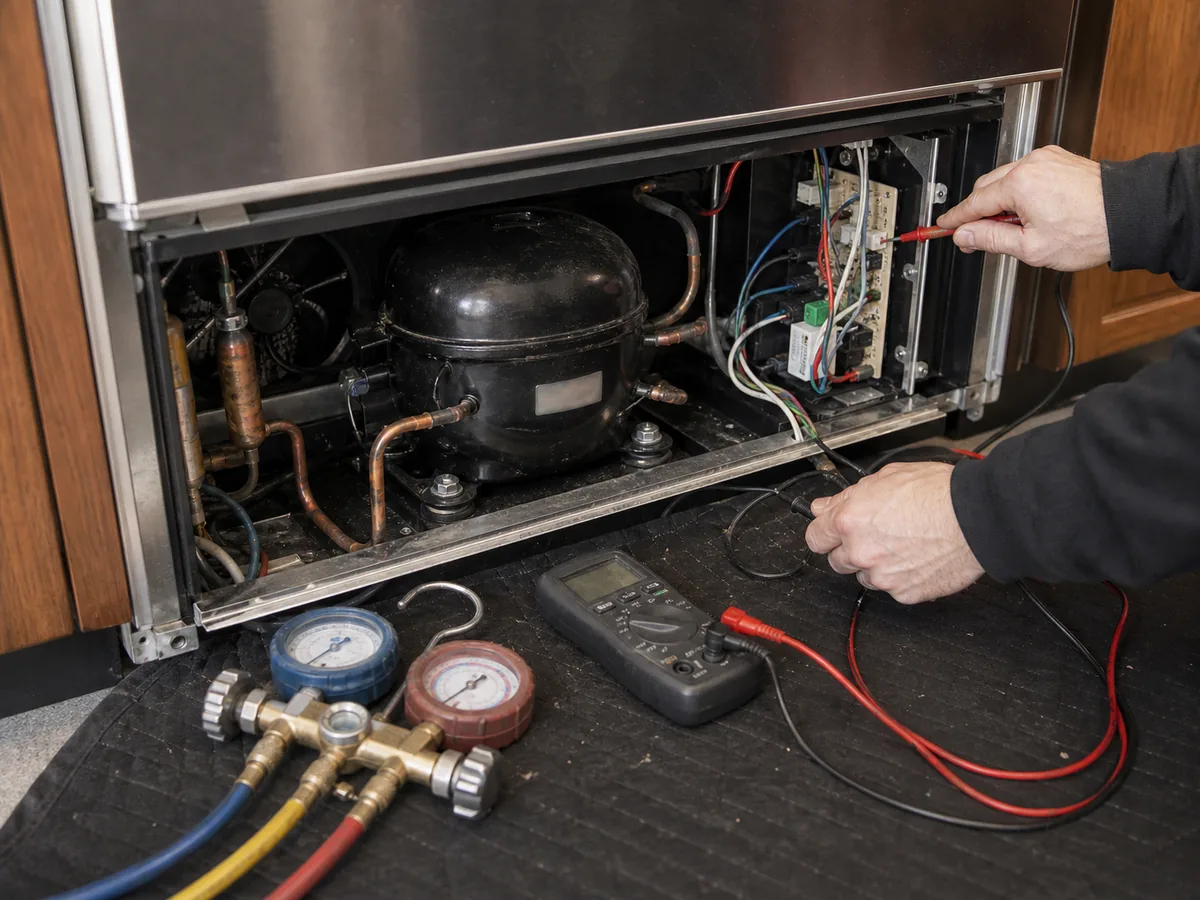
A steady low buzz from the bottom-front is usually the compressor working, and on most units that is normal — until it grows louder, harsher, or pairs with a compartment that is losing cold. A compressor that has begun to labor is the costliest end of the range, so we confirm it with readings rather than ear alone.
Evaporator fan rattle
A rattle or whir from inside the cabinet, often louder with the door just opened, points to the evaporator fan. A worn bearing or a blade ticking against frost is a bounded repair — and catching it early matters, because a fan that quits also starves airflow and warms the box.
Condenser fan noise
A rattle or hum from the lower grille area can be the condenser fan, especially when its blades are loaded with the dry-season dust Los Altos gardens drive indoors. Sometimes the fix is a cleaning and a re-seat; sometimes the motor is on its way out.
Ice-maker clicks
A periodic click as the harvest cycle runs is normal. Rapid or constant clicking, or clicking with no ice, points to the harvest mechanism or the water supply — the ice maker and water-line page covers that path.
Normal defrost gurgle
Pops, gurgles and a soft tick a few times a day are the refrigerant and defrost cycle doing their job. These are the sounds you can safely ignore — they are a sign the system is healthy, not failing.
Install buzz and vibration
A case touching a custom panel, or a unit knocked out of level by a floor refinish, turns ordinary running vibration into a loud hum. We always check the install first, because levelling and clearance cost far less than a motor.
Wine collectors
Why vibration is its own problem on a wine unit
For the many Los Altos homes with a built-in Sub-Zero wine column, noise is not just an annoyance — it is a storage risk. A worn compressor mount or a failing fan bearing sends a low vibration through the cabinet, and that vibration disturbs the sediment in bottles meant to lie undisturbed for years. A collection in a butler's pantry off the dining room, or in the lower level of a Hills estate, is being protected from movement as much as from heat. So on a wine unit we treat a new buzz or rattle as a reason to look, not to wait, and we check the mounts and bearings alongside the temperature the way our wine-storage guidance describes.
Step by step
How to describe the noise so we can place it
Locate where the sound lives. Stand at the unit and decide whether the noise comes from the lower grille area, the back, or inside the cabinet. Bottom-front usually means the condenser fan or compressor; inside means the evaporator fan or ice maker.
Time it against the cycle. Note whether the sound runs constantly, comes only when the compressor starts, or shows up on a schedule. A gurgle or pop a few times a day is normal defrost; a constant rattle is not.
Separate buzz from rattle from click. A low electrical buzz, a mechanical rattle, and a sharp repeating click are three different parts. Describing which you hear shortcuts the diagnosis over the phone.
Check for contact and level. A cabinet touching custom millwork, or a unit out of level after a floor refinish, can transmit normal vibration as a loud hum. We confirm the install before condemning a motor.
Note any temperature change. A new noise paired with a warming compartment raises the priority — a failing fan that is also starving airflow needs attention before food or wine is at risk.
Next step
Tell us the sound, we'll bring the part
A clear description of where the noise lives and when it happens usually lets us pre-stock the likely fan, mount or part before the visit. If the noise comes with a warming compartment, start with the freezer-not-freezing or not-cooling page; if you suspect the compressor, the sealed-system page explains how we confirm it. Every visit opens with the $89 diagnostic, applied to the repair, with a 365-day warranty on the work.
A steady low buzz usually comes from the compressor or an electrical component at the base; a higher mechanical buzz or rattle is more often a fan with a worn bearing. The two are diagnosed differently, so locating the sound — bottom-front versus inside the cabinet — is the first step we take.
Which Sub-Zero noises are normal and which mean trouble?
Occasional gurgles, pops and a soft hum as the system cycles or defrosts are normal. Persistent rattling, grinding, loud humming that wasn't there before, or a sharp repeating click points to a fan, the compressor, or the ice maker and is worth a look — especially if a compartment is also warming.
Why does my refrigerator sound so loud all of a sudden?
Often the appliance hasn't changed — its surroundings have. Los Altos homes are quiet, and a kitchen remodel, a floor refinish that left the unit slightly out of level, or a cabinet panel now touching the case can make ordinary running noise carry. We check the install first, because that fix is far cheaper than a motor.
I have a Sub-Zero wine column that vibrates — does that matter?
It can. Vibration from a worn compressor mount or a failing fan bearing travels through a wine cabinet and disturbs sediment in bottles meant to rest undisturbed for years. For a serious collection it is worth correcting promptly; our wine-storage pages cover why stability matters as much as temperature.
Is a clicking ice maker a problem?
A periodic click as the ice maker cycles is normal. A rapid or constant click, or clicking paired with no ice, points to the harvest mechanism or a water-supply issue — the ice maker and water-line page walks through that path.
 Los Altos Sub-Zero Appliance Repair